
Building on the six-year dataset n=1 described in our last post a broader theoretical implication emerges.
The longitudinal dynamics are difficult to reconcile with a strictly linear model of biological aging. Instead, they support a systems-level interpretation: epigenetic age acceleration (EAA) behaves as a marker of inflammatory network stability rather than cumulative chronological damage.
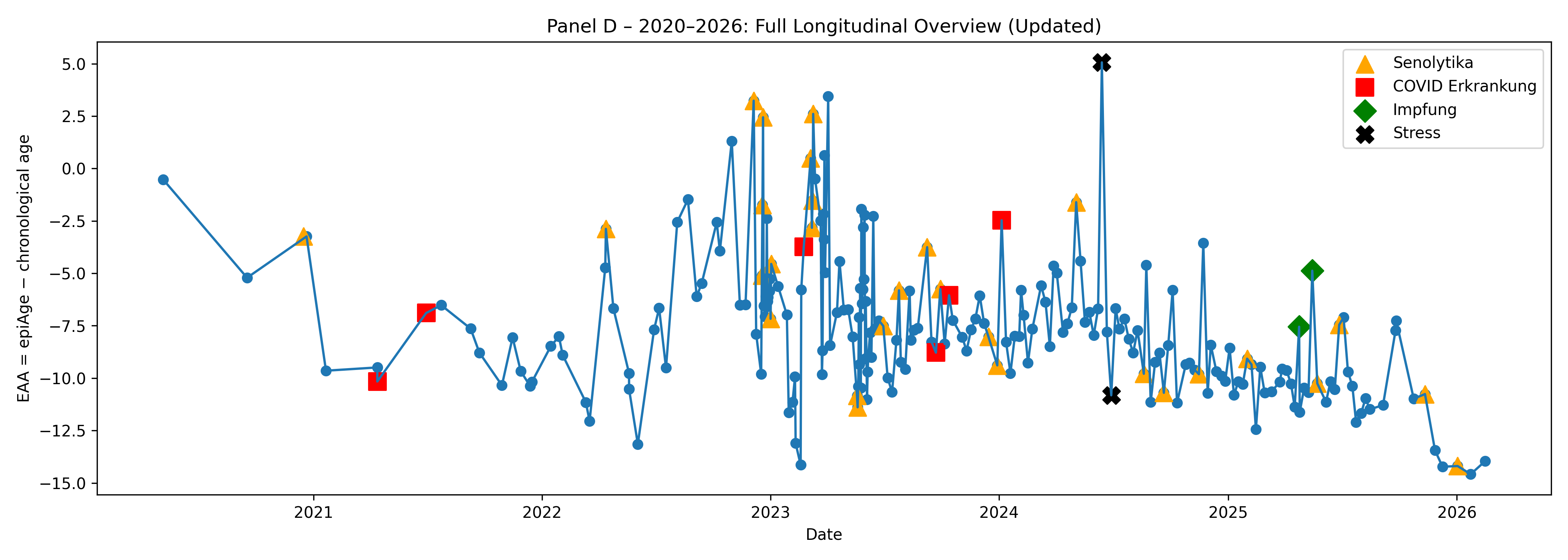
Across >225 epiAge measurements, three distinct phases were observed.
Phase I (2020–2022) was characterized by high variance, pronounced oscillations, and activation of genetically vulnerable pathways. Early in the observation period, mucosal immune activation Gliadin-IgA 185 U/ml declined to 12 U/ml, coinciding with the first signs of systemic recalibration.
Phase II (2023) showed transitional stabilization following smoking cessation and alcohol cessation.
Phase III (2024–2026) demonstrated persistent negative values, marked variance reduction, and convergence toward a stable epigenetic plateau approximately a decade and more below chronological age.
This pattern suggests that epigenetic age reflects the coherence state of a genetically structured inflammatory network.
Genomic profiling identified vulnerability axes in mucosal immunity (HLA-DQ2.5/DQ8), endothelial regulation (APOE E2/E3, NOS3), metabolic signaling (TCF7L2, FTO, IL6), proliferative control (8q24), and stress regulation (FKBP5, NR3C1). These axes function as “manifestation nodes”— preferential portals where systemic inflammatory load becomes phenotypically visible.
When inflammatory setpoint is elevated, these nodes express.
When systemic load declines below a threshold, expression attenuates and epigenetic variance collapses.
Senolytic clusters exhibited a reproducible biphasic signature: short-term EAA elevation followed by delayed reductions below baseline. This pattern is consistent with controlled perturbation followed by network recalibration.
Importantly, molecular stabilization was paralleled by phenotypic changes: improved skin quality, new frontal hair growth, absence of carotid progression, stabilization of benign prostatic enlargement, and sustained metabolic normalization.
The convergence of molecular and clinical indicators argues against assay noise and supports a genuine systems-level transition.
Taken together, these observations support a threshold-based model of aging:
Biological age reflects the emergent stability of an inflammatory network shaped by genetic architecture. Durable rejuvenation manifests not as linear reversal of time, but as reduced variance, faster recovery after stress, and consolidation around a lower epigenetic setpoint.
In this framework, aging is not merely accumulation — it is instability.
And instability, under certain conditions, can be stabilized.
++++
Source
Martin Berlet / epiAge
Illustrations
nadege / pixabay
epiAge
 Back to all posts

